
Assalamualaikum.
Saya lepasan kos bioteknologi makanan. Ada sesuatu yang saya tercari-cari dari dulu. "Allah, do I deserve to know all of that?" Emm. Saya memang minat genetik. Suatu hari yang polos dan damai di matrikulasi menemukan saya dengan sekeping akhbar tempatan. Ceritanya berkenaan Cili Bangi. Terus, zaman sekolah saya di imbas kembali. Ada beberapa paparan kisah dari majalah 3 (siri dokumentari yang amat popular ketika itu..kini..Allahua'alam) berkenaan dengan kisah Cili tersebut. dari situ saya mula mengenal dengan lebih indah dan terpesona dengan kejadian asid amino, mutasi dan DNA. Alhamdulillah. Hari-hari saya, saya bawa semangat untuk menjadi seperti saintis itu suatu hari nanti.
Tahun pertama saya di USIM, saya dikejutkan dengan satu kertas pengumuman berkenaan tajuk tesis pelajar tahun 4. Ada 'hero' saya di situ. Allahurabbi, barulah saya tahu, Assoc. Prof. Dr. Ahmed Mahir kini mengajar di USIM selepas bersara dari UKM. Hari-hari indah berterusan untuk menantikan prof dapat mengajar kami. Allah punya kuasa. Tahun 2, kami belajar genetik bersamanya. Pergh! lab dapat A. Exam subjek, dapat B je. hehe. Apa pun, setelah prof keluar...saya dah lupa dan hilang arah berkenaan bidang yang makin berkembang di Malaysia ni. Hmmph. Apa pun, saya ada terbaca berita untuk dikongsikan. Bukan berita baru, tetapi sudah setahun yang lepas.
I just want to share what i've found. That's all.
Assalamualaikum.
Cilibangi, a very hot but tasty Chili in the country, is making a comeback
WEDNESDAY, 18 AUGUST 2010 11:15


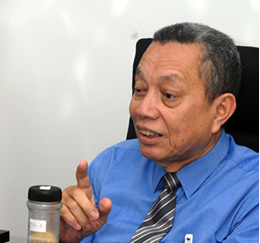 Genetics scientist also eager to promote Tomato Ehsan
 By Abdul Ghani Nasir (Click here for Brief Biography of Dr. Ahmed Mahir)
BANGI, 18 August 2010 – Cilibangi, a variety of chilly developed by a genetics scientist from UKM in 1987 and known for being the hottest chilli in the country then but had almost disappeared is set to make its return soon.
This very hot but tasty chilli was developed by Associate Prof Dr Ahmed Mahir bin Mohamed Mokhtar Bakri, 63 but has since almost disappeared following his retirement from UKM in 2003.
“After retiring from UKM, I served in University of Islamic Sciences Malaysia (USIM). There some Ph.Ds students cultivated Cilibangi for their research. But it was only in the laboratory,” said Dr Mahir.
A few farmers including one in Kuang tried to cultivate Cilibangi but it was almost forgotten except for a few bottles of its seeds that the scientist kept in a fridge.
Since leaving UKM, he almost brought Cilibangi to Canada where with two of his colleagues they formed a joint venture company to produce spices for exports, but the call to come home was too strong for this Ipoh born scientist to ignore.
True the delicious and hot taste of Cilibangi had disappeared from the shops in Bangi and the UKM campus and is now almost unheard of but is set to make a comeback, this time with a bang to give the current popular Cili Kulai a run. All the six varieties of Cilibangi fruit all year long.
Besides its hotness compared to the other varieties of chillis now in the market, which the connoisseurs considered as ‘tasteless chilli’, Cilibangi which grows upright and disease resistant will be given more attention by Dr Mahir who plans to cultivate it on a big scale.
He is now back with UKM as Chief Technology Officer (CTO) at UKM Technology Sdn Bhd where he will work towards the commercialisation of Cilibangi. Besides Cilibangi, he also plans to revive the cultivation of the Tomato Ehsan series 1 and 2, lemongrass and water melons.
Cilibangi promises good returns to cultivators as the chilli fruits at the same time and thus can be harvested altogether using machines. Consumers can also get dried chilis from Cilibangi plants.
The project started at the UKM campus in 1987 was more experimental with the chilli only sold to UKM staffs since 1995 with the seeds distributed to help poor farmers.
We have passed that phase, said Dr Mahir. Crop breeders like Dr Mahir will now be given more encouragement and capital in line with UKM’s mission to commercialise its research findings.
Dr Mahir has already been given a plot of a half acre in the UKM campus to cultivate the seeds of Cilibangi since the variety cannot be breeded through tissue culture.
He hopes to get a bigger plot of flat land to enable tractors to be used to harvest the chilis. For a start a small machine using motors will be built at the UKM engineering store after a prototype built earlier could not be reused.
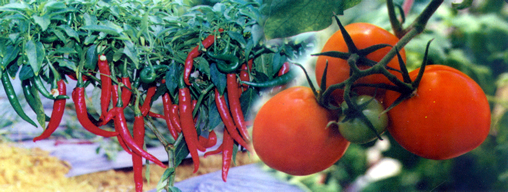
Once the chili cultivation is in full swing a much bigger machine attached to a tractor will be used.
“The machine that I suggested is a modified one from an old model and it can pluck the chilis without disturbing the leaves.
“What is good about the machine is we can pluck all the chilis from each plant to ensure that it will bear more fruits the next season,” said Dr Mahir.
The success of planting and harvesting Cilibangi may in the end allow us to lower our imports of chilli from China, India, Thailand and Indonesia valued at RM95 million per year, he said.
If the plans by Dr Ahmed Mahir goes smoothly every acre will be planted with 8,000 plants of Cilibangi with each plant capable of producing three kilograms of chilis every three months for four harvests in a year. 
Dr Ahmed Mahir can be contacted at his e-mail: ahmedmahir@yahoo.com
Translated by Abdul Ghani Nasir
Dr Ahmed Mahir, an excellent scientist awardee
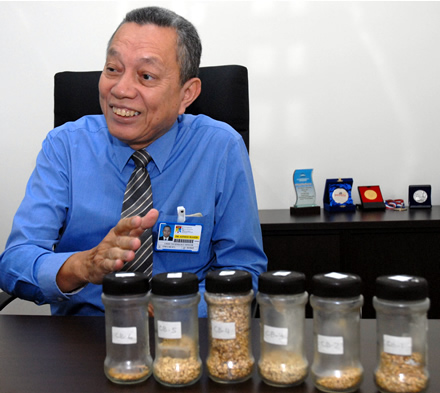
BANGI, 18 August 2010 -- Dr Ahmed Mahir obtained his Diploma in Agriculture from the then Agricultural College, Serdang in 1971 before getting his Bachelors of Science degree (Crop Science) from the Louisiana State University, United States, in 1975.
He obtained his Master’s degree (Crop Breeding) in 1977 and his Ph.D (Plant Resistance Breeding) from the Missouri-Columbia University, United States in 1981.
He served at UKM from 1977 to 2003 and was the Head of the Department of Genetics, Faculty of Life Sciences and Head of Cilibangi Project 1987-2003 before retiring and later joining Universiti Sains Islam Malaysia (USIM).
Dr Mahir received UKM’s Research in Science Award (1996) and other awards including UKM’s Gold Medal , Expo Research & Innovation 2004.
Last year he won the Eureka’s Gold Medal, at The Belgian and International Trade Fair for Technological Innovation.
p/s: reff from UKM website. (click here)


4 comments:
Assalamu'alaikum
Cerita menarik ni..
Waalaikum salam..
sahabat jauh, lame xdengar crite.=)
hu, teringt ade org tu nk prof jd co-supervisor final year projeects.. oh prof, jasamu mmg dikenang.....=)
hoho... teringat lak wat tesis dolu2...
Post a Comment